Fixing Anterior Hip Pain While Squatting
How to fix your mobility and make squats pain free!
Anterior hip pain while squatting can happen to a lot of people (myself included), it can be a little more difficult due to differences in limb and torso length as well as other factors.
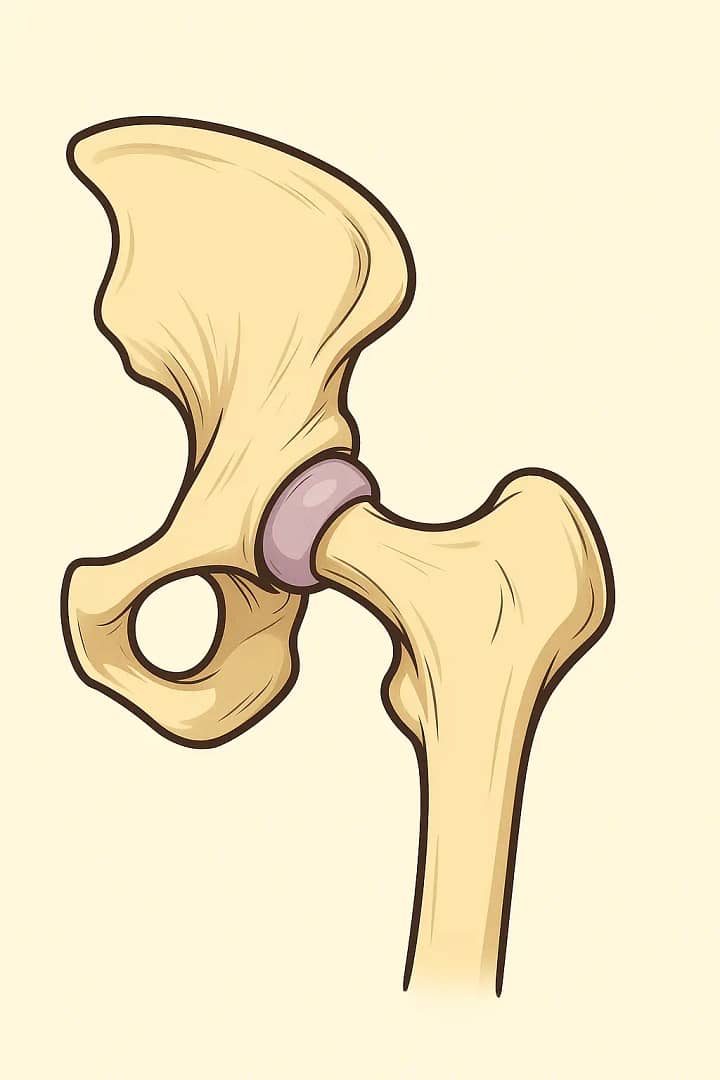
Because of some of these issues, squatting, especially barbell back squatting, can cause anterior hip pain, or pain in the front of the hip.
Are deep squats dangerous? No, but they can be if you lack the proper mobility to avoid compensating for poor movement.
“Because of some of these issues, squatting, especially barbell back squatting, can cause anterior hip pain, or pain in the front of the hip. “
If you are experiencing pain from deep squatting, there are things you can do to help minimize this pain and make the squat feel more natural for you.
Warning:
As always, consult a medical professional if you think there is something wrong!
Reasons for Hip Pain When Squatting
Because there are so many joints involved in the squat, there are so many things to consider if you’re having pain during the squat.
The ankles, knees, hips and lower back are the key players during the squat.
It is extremely important that you have the necessary mobility at the necessary joint angles to not only optimize your squat but to limit possible injury.
We’re all built differently. Depending on limb length, height and mobility, the squat will be a more natural movement for some versus others.
For those who have longer femurs or torsos, movements like squats and deadlifts become a little more problematic because it requires us to lean forward or hinge at the hips more. This can possibly cause anterior hip pain.
There are many reasons for experiencing anterior hip pain when squatting but these are some of the most common that I see when working with clients:
I will show you below how to deal with each of these issues that may be hampering your squat.
Short Hip Flexors/Adductors and Exercises to Fix it
The hip flexors and groin muscles can become short and tight from prolonged periods of sitting. This causes a problem because it limits the hip mobility you will have during the squat, causing you to have to round your back or “butt wink”, which is where the low back rounds under at the bottom of the squat.
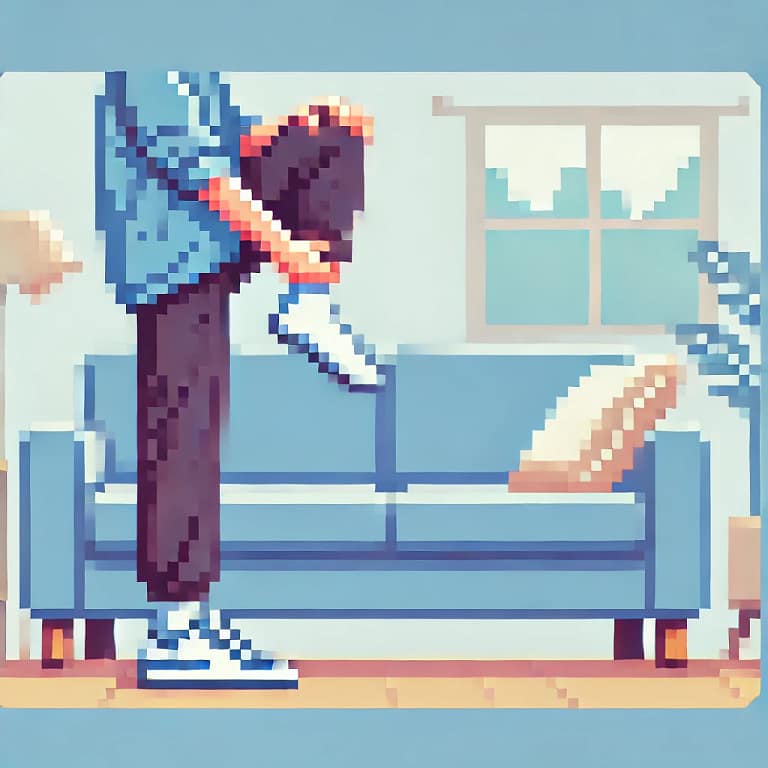
Couch Stretch
The hip flexors can become short and tight from prolonged periods of sitting.
Kneel with one knee in front of a wall and slide back until you can place your leg vertically on the wall with your toes pointing straight to the ceiling. Try to keep your torso upright, and you will feel a major stretch in the hip flexor (might feel like your quad) of the leg that is against the wall. Try to hold this stretch for a minute on each side.
One side may be tighter than the other. Do an extra set on that side to try and balance the system.
This stretch can be performed right off of a couch. Put a pillow or a pad under your knee to make it more comfortable while you torture yourself!
Couch Stretch: 1-3 sets of :60 each leg
Piriformis Stretch
The gluteus medius can also become tight from sitting. Loosen the glutes and reclaim external rotation of the hip with the piriformis stretch.
Place your leg perpendicular to you on a bench or a couch or a chair. You can brace yourself by putting your hands on either side of your front leg. Your back leg can simply bend or stay straight depending on the height of the box you’re using.
For some, just holding this position is enough of a stretch for the glutes. If you want to make the stretch more effective, bring your chest towards your knee and hold that position.
To work up to this, you can place a pad or pillow underneath the knee that is on the bench.
Piriformis Stretch: 1-3 sets of :60 each leg
Loaded Butterfly
The loaded butterfly will help you increase the mobility and strength of your groin muscles. Improving this may also help you get your legs wider in the squat, allowing your hips to fold better.
Grab a light set of dumbbells (10-20 lbs if this is your first time) and take a seat on the floor with your back against a wall. Put your feet together and let your knees hang out to the sides.
Place the head of the dumbbells on each knee. You should immediately feel a stretch in the adductors simply by having the weight on your knees. Take a deep breath and use the dumbbells to lower your legs into a deeper stretch. Obviously don’t push past anything too painful.
Hold this stretch while taking a deep breath for 5-10 seconds. Now I want you to press your knees back up against the heads of the dumbbells forcing a small contraction of the adductor muscles. Immediately return to the stretch and hold again.
Alternate between stretching and contracting the groin muscles and you will start to notice that you can go deeper with each stretch. Try to perform 10 repetitions or more and hold the stretch portion for however long you’d like. This one starts to feel better the longer you go.
1-3 sets 10 reps with a 5-10 second hold at the stretch portion of each rep
Ankle dorsiflexion
Ankle range of motion, namely ankle dorsiflexion, is one of the most overlooked aspects of squat ability, but it is one of the first things I test with my clients who are having hip pain, back pain, or even knee pain.
The more ankle dorsiflexion you have, the easier it is for you to keep your torso more upright in a squat. This allows you to emphasize quad strength more than hip strength when squatting and goes a long way in mitigating anterior hip pain.
You can check your own ankle dorsiflexion. All you need is a wall.
The aim of this test is to see how far away you can have your foot from the wall, touch your knee to the wall and still have your foot flat on the floor. It sounds confusing but it isn’t.
Take off your shoes and place your hands on a wall in front of you. Place your front foot about 3-5 inches from the wall. While keeping your foot completely flat on the floor, try to touch your front knee to the wall. You fail if your front heel rises off the floor. If you can go further than 3 inches, great!
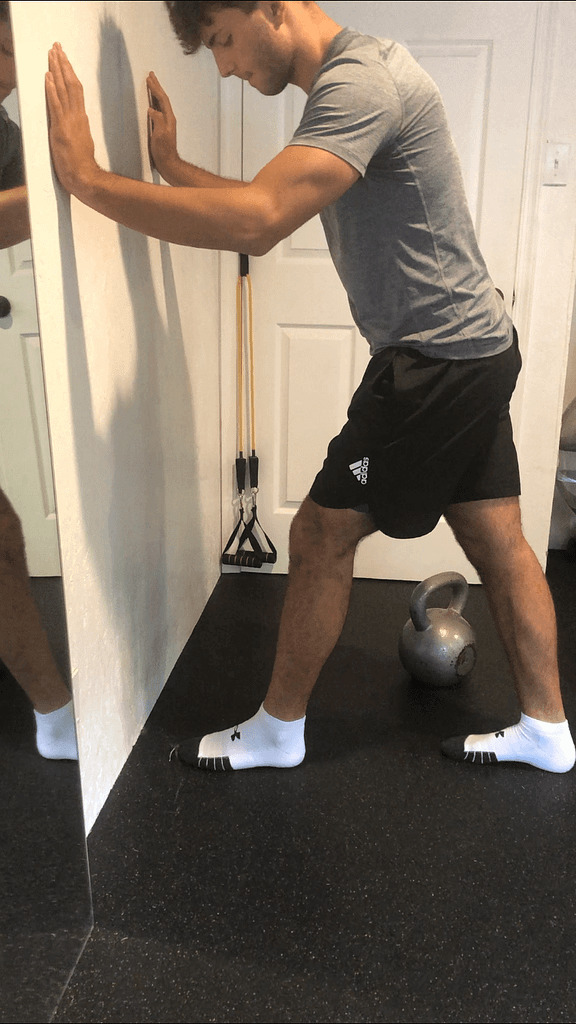
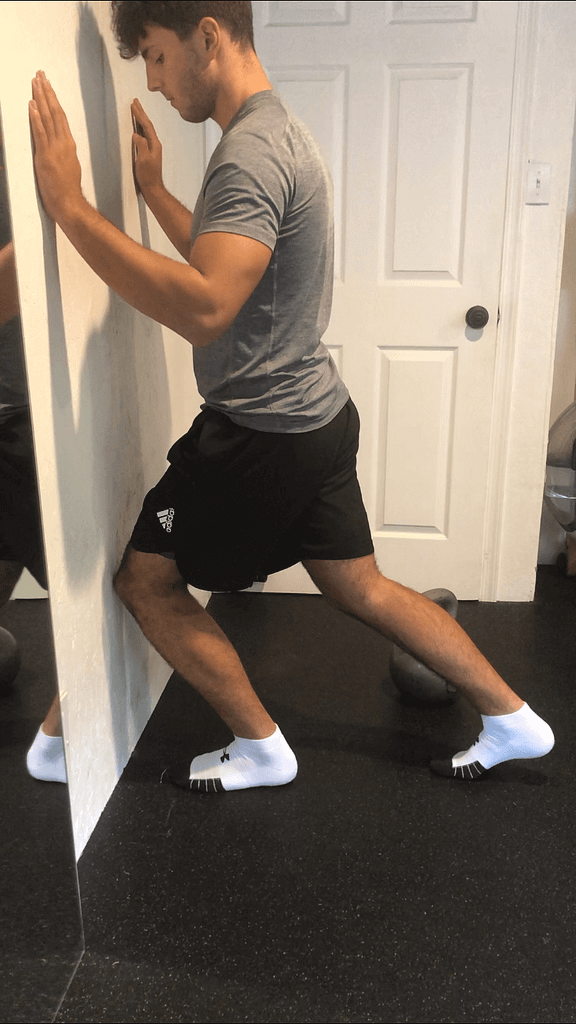
If you are having hip pain during the squat, test your ankle range of moment (rom)
Note how far away you are able to get each foot from the wall. Is your ankle range of motion equal on both sides? More troublesome than poor range of motion is great range of motion on one leg but poor range of motion on the opposite. This can cause a hip shift during the squat. In other words, your body will shift or compensate for your poor movement mechanics and place more stress on one side of the body, possibly leading to anterior hip pain. This is why sometimes the painful area is not always the dysfunctional area.
You can do soft tissue work on the tight areas, which are the calf and soleus. You can use a foam roll or a kettlebell to loosen up the tight soleus muscles.
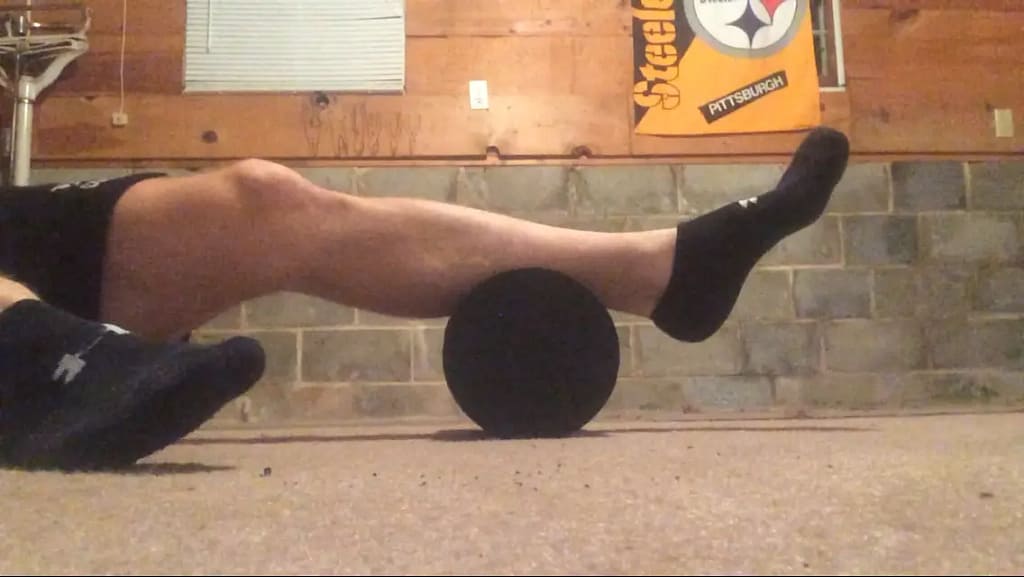
With a foam roller you can roll up and down and side to side. Place your other leg on top of your shin to add pressure to the soleus muscle. Spend one minute per leg. If one leg feels tighter, spend a second set there.
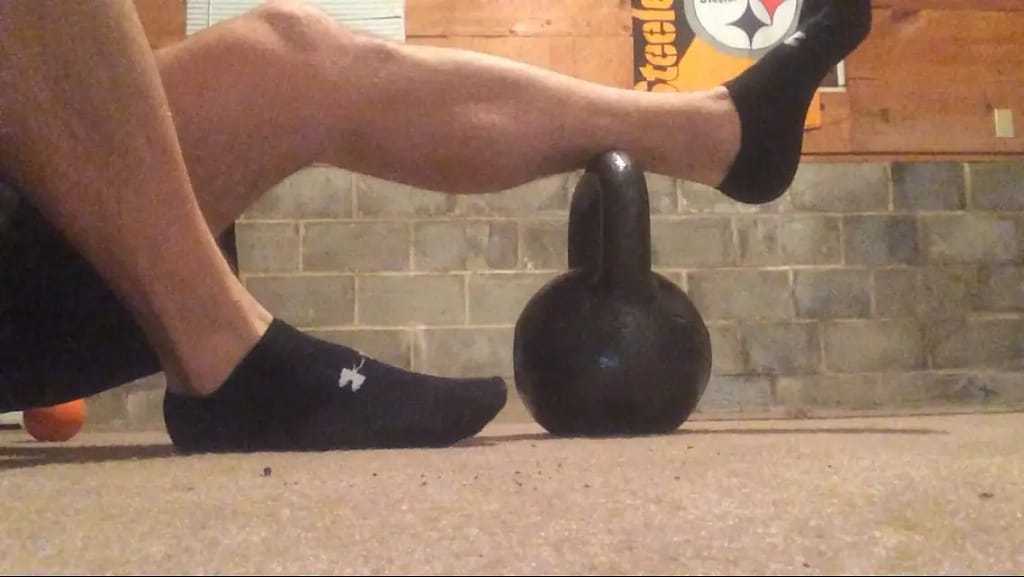
If you have a kettlebell available you can perform the same movement rocking side to side. The handle of the kettlebell will be a little more pinpointed than the foam roller. Once again, perform an extra set on the side that feels tighter.
After loosening up the soleus muscles it’s time to stretch them.
If you are lacking ankle range of motion in both ankles you can find numerous ways to stretch. If you have a barbell, you can work on the bottom of your squat and improve your ankle range of motion at the same time!
This is a neat stretch to do as a warmup prior to back or front squatting sessions.
Hold a barbell in front of you against your thighs. Start to descend into the squat and place the bar just above your knees. As you sink down the bar will aid you in squatting deep, but also put a stretch on your calf muscles and challenge your ankle dorsiflexion. Stay at the bottom for however long is comfortable.
1 set of :60
It’s very important to build mobile ankles. If your ankles are very tight and you are still having trouble getting the necessary amount of dorsiflexion to be able to squat with an upright torso, you can elevate your heels. This will allow you to squat with a more upright torso and place more load on the thighs rather than the hips.
You can elevate your heels with a slant board, some weight plates, or even Olympic lifting shoes which have around a one inch lift in the heel.
Read more about ankle mobility here.
Balancing Leg Strength
Because most of us perform bilateral exercises, it is possible to develop imbalances in strength from left to right side.
When I was experiencing hip pain, I measured the circumference of my legs at mid thigh. There was a 1 inch difference in each leg.
I focused on single leg strengthening exercises for a while and have since brought the difference down to a quarter inch, and my hip pain during the squat has become almost non-existent.
If you don’t know where to begin, try these exercises.
Split Stance Hold
This is a great exercise to begin balancing leg strength. It requires no equipment, however if you are a novice, it is a good idea to have something to hold on to for balance. I’m going to warn you: no matter how strong my legs get, this movement always humbles me. I’ve had clients squat in the 400’s and 500’s, and this movement is their least favorite. Because it’s effective!
Standing upright with feet pointing forward, slide one of your legs behind you. Your feet should be about 24 inches apart and about shoulder width apart for increased balance.
Bend at your knees and keep your front shin perpendicular to the floor and lower until your front leg is at a 90 degree angle. Do your best to equalize the force between both legs during the movement. In other words, try not to lean only on your back leg or front leg. Keep the pressure as equal as possible.
Try to hold this movement for :30 on each side. Your quads will be burning by the end of the second set guaranteed! Eventually work up to a one minute hold per side or add dumbbells to increase resistance.
3 sets of :30 each leg
Split Squat
Once you have mastered the ability to hold your balance in the split stance hold, next you can lower your back knee to the floor before returning to the start position.
This is a split squat. Perform 10-15 repetitions per side.
You can superset these two movements to really work on quad strength!
You can also elevate your front foot to increase the range of motion of the movement.
3 sets of 15 reps per leg
RFESS (Bulgarian Split Squat)
Ah, the rear foot elevated split squat, also known as the Bulgarian Split Squat, (I have no idea why).
This move will change your quad strength, hip flexor mobility, and single leg stability.
Balancing on your front foot, place the laces of your back foot on a bench or couch behind you. Make sure your front leg is about 2 feet in front of the bench. You may need to hop forward until your front foot is in a good position.
Bend your front leg and let your back knee come down towards the floor. When you get to about 90 degrees of flexion with the front foot, push your heel into the floor and return to the start position.
It might be a good idea to have something next to you to hold onto for balance if you’re just learning this movement.
Aim for 10-15 repetitions per leg. When your balance is good, you can hold dumbbells in each hand for extra resistance. This movement may leave you with sore quads for days!
As you make progress with this exercise, your squat will improve
3 sets of 10-15 reps per leg
Low Back Strength
Your anterior hip pain might be rooted in your inability to stay up right during the squat, but it may also be because the low back isn’t strong enough and you don’t have proper trunk control.
Seated Good Morning
This is one of the best ways to strengthen your lower back with minimal equipment. The seated good morning only requires a bench or a chair.
Sit on the bench with your legs on either side.
Your feet should be a little wider than shoulder width apart but you can adjust them to what feels best.
Keep your shoulder blades retracted and your back flat and lower your chest towards the bench. Your feet should stay flat on the floor. Hold at the bottom for a brief pause before returning to start.
You can use pads or pillows as a target for your chest and slowly work your way down to the bench as you become more comfortable with the exercise.
When you are ready to add resistance you can put a bar on your back.
3 sets of 5-10 slow reps
Loading with dumbbells is easier because it is safer and requires less shoulder mobility.
Conclusion
Don’t push through pain!
There are various reasons you can be experiencing hip pain when squatting. The squat is a high demand activity that requires a high level of hip mobility, ankle mobility and balanced leg strength.
Address these factors and make your squat pain free!
Training
| Training Protocol (1 times per week) | ||||
| Focus | Exercise | Sets | Reps | |
| Hip Mobility | Couch Stretch | 1 | :60 Each | |
| Piriformis Stretch | 1 | :60 Each | ||
| Loaded Butterfly | 1 | :60 | ||
| Ankle Dorsiflexion | Soleus Smash | 1 | :60 per leg | |
| Soleus Stretch | 1 | :60 per leg | ||
| Barbell Ankle Dorsiflexion | 1 | :60 | ||
| Balancing Leg Strength | Split Stance Hold | 3 | :30 each leg | |
| Split Squat | 3 | 8-12 reps each leg | ||
| RFESS | 3 | 10-15 reps each leg | ||
| Lower Back Strength | Seated Good Morning | 3 | 5-10 reps | |
Key Takeaways
References
- Endo Y, Miura M, Sakamoto M. The relationship between the deep squat movement and the hip, knee and ankle range of motion and muscle strength. J Phys Ther Sci. 2020 Jun;32(6):391-394.
- Lamontagne M, Kennedy MJ, Beaulé PE. The effect of cam FAI on hip and pelvic motion during maximum squat. Clin Orthop Relat Res. 2009 Mar;467(3):645-50.
- Legg HS, Glaister M, Cleather DJ, Goodwin JE. The effect of weightlifting shoes on the kinetics and kinematics of the back squat. J Sports Sci. 2017 Mar;35(5):508-515.
- McCurdy K, O’Kelley E, Kutz M, Langford G, Ernest J, Torres M. Comparison of lower extremity EMG between the 2-leg squat and modified single-leg squat in female athletes. J Sport Rehabil. 2010 Feb;19(1):57-70.
- Sriwarno AB, Shimomura Y, Iwanaga K, Katsuura T. The relation between the changes of postural achievement, lower limb muscle activities, and balance stability in three different deep-squatting postures. J Physiol Anthropol. 2008 Jan;27(1):11-7.